
Every year, thousands of people survive cardiac arrest not because of luck, but because someone nearby knew exactly what to do.
CPR keeps blood flowing, but it’s often the AED that restores a normal heartbeat. Together, they form a complete response. Separately, they leave a gap that no one hopes to discover in a real emergency.
This is why more instructors, healthcare advocates, and community organizations are calling for AED training to be a standard part of every CPR course. Not an optional add-on, not a separate class, but a natural part of learning how to respond when it matters most.
Keep reading to understand why the two go together and what it means for your own preparedness.
What Is AED Training and Why Does It Matter?
AED training teaches you how to use an Automated External Defibrillator to restore a normal heart rhythm during sudden cardiac arrest. When used alongside CPR, it significantly increases a person’s chance of survival.
How an AED Works in an Emergency
An AED is a portable device that analyzes the heart’s rhythm and delivers an electric shock if needed to help it beat normally again. It does the thinking for you. You just need to follow the steps.
Here is what happens when someone uses an AED in a real emergency:
- The device is turned on and immediately begins giving voice instructions
- Adhesive pads are placed on the person’s bare chest
- The AED reads the heart rhythm automatically and decides whether a shock is needed
- If a shock is recommended, the device tells you to stand clear and prompts you to press a button
- CPR continues between shocks until emergency services arrive
You don’t have to figure any of this out on your own. The AED walks you through every single step.
Core AED Skills You Practice
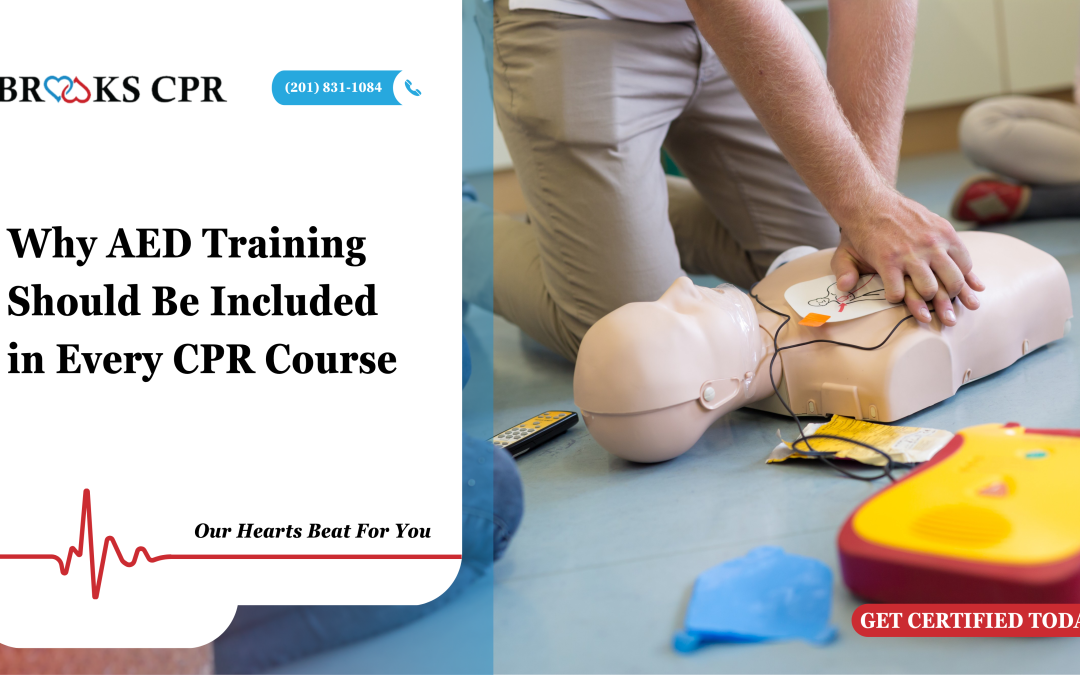
You will practice four essential AED skills in class: turning on the device, placing the pads, following voice prompts, and clearing before a shock. Here’s what each one looks like in a real training session:
- Turning on the AED and letting it lead you through the process with clear voice prompts
- Placing the pads correctly on the person’s chest so the device can read the heart rhythm
- Following audio and visual instructions in real time, so you’re never guessing what to do next
- Clearing the area before a shock is delivered, which is a critical safety step that many people overlook until they practice it
- Using trainer AEDs on manikins so the experience feels familiar, not frightening, before you ever face a real situation
That last point matters more than people realize. Practicing on a trainer AED removes the hesitation. You’ve already done it before.
AEDs are closer than you think. In New York and New Jersey, you’ll find them in places like:
| Location | Examples |
| Offices & Workplaces | Manhattan office buildings, corporate parks in NJ |
| Schools | Public and private schools across Brooklyn, Queens, and NJ |
| Gyms & Fitness Centers | Local gyms, YMCAs, and recreation centers |
| Community Centers | Libraries, houses of worship, town halls |
| Public Spaces | Airports, transit stations, shopping centers |
Knowing where they are is helpful. Knowing how to use one is what saves a life.
Why AED Training Should Be Part of Every CPR Course
Using an AED within the first few minutes of cardiac arrest can increase survival rates by as much as 70 percent.
CPR alone, while critical, cannot restore a normal heart rhythm the way an AED can. Together, they give a person the best possible chance.
Here are five reasons why AED training belongs in every CPR course:
1. The survival statistics speak for themselves
- Survival rates for sudden cardiac arrest drop by 7 to 10 percent for every minute without defibrillation
- When CPR and an AED are used together within the first three to five minutes, survival rates can reach 70 percent or higher
- CPR alone, without defibrillation, has an average survival rate closer to 5 to 10 percent in out-of-hospital cardiac arrests
Every minute matters. Having both skills means you’re not leaving anything on the table when someone’s life is at stake.
2. AEDs are already everywhere around you
There’s a good chance you walk past an AED every single day without noticing it. Schools, offices, gyms, transit stations, and community centers across New York and New Jersey are required to have them.
Knowing they’re there is one thing. Knowing how to use one the moment you need it is another. Training makes that knowledge automatic.
3. It clears up the fears that hold people back
Two myths come up in almost every class:
- “I might hurt someone.” An AED will not deliver a shock unless it detects a rhythm that actually requires one. The device makes that call, not you. You cannot accidentally shock someone who doesn’t need it.
- “It’s too complicated for me.” AEDs are built for everyday people, not just medical professionals. The voice prompts are clear, the steps are simple, and the device pauses to let you keep up.
Most people are surprised by how approachable it is once they actually try it.
4. Practicing builds the confidence to act
Reading about how to use an AED and actually using one are two very different things. Hands-on practice with a trainer AED is what turns knowledge into instinct.
In our classes, we break AED use into simple, repeatable steps so that even first-time learners in New York and New Jersey leave feeling confident rather than overwhelmed. That confidence is what makes someone actually step forward in an emergency instead of freezing.
5. CPR and AED training together is simply more complete
CPR and AED skills are two halves of the same response. Teaching one without the other leaves a gap that could matter enormously in a real situation.
A person who only knows CPR may keep blood flowing but still be unable to restore a normal heart rhythm.
A course that includes both gives you a full, well-rounded response that reflects how emergencies actually unfold.
Choosing a CPR Course with AED Training in NY & NJ
The right CPR course in New York or New Jersey should include hands-on AED training, recognized certification, and flexible options that fit your schedule and setting.
Not every course offers all three, so it’s worth knowing what to look for before you sign up.
What to Look For in a Local Class
Before committing to a course, here are the key things to confirm:
1. AED training is included with actual hands-on practice
A course that only mentions AEDs in passing isn’t enough. Look for a class where you physically practice on a trainer AED, place the pads, follow the prompts, and go through the full sequence. That repetition is what makes the skill stick.
2. Certification is recognized by New York and New Jersey employers
Not all certifications carry the same weight. If you need your card accepted by a hospital, school, corporate HR department, or licensing board, confirm that the course follows American Heart Association (AHA) or equivalent standards.
This matters especially for healthcare workers, educators, and anyone renewing for a job requirement.
3. On-site group training is available
If you’re coordinating training for a workplace, school, or organization, look for a provider that comes to you. On-site training is more convenient, more cost-effective for larger groups, and allows your team to practice together in the actual environment where an emergency could happen.
Here’s a quick checklist to bring to your search:
| What to Confirm | Why It Matters |
| AED hands-on practice included | Builds muscle memory, not just awareness |
| AHA or recognized certification | Accepted by employers and licensing boards in NY & NJ |
| On-site training available | Convenient for schools, offices, and large teams |
| Class size is manageable | Smaller groups mean more time with the instructor |
| Flexible scheduling options | Works around your team’s availability |
How We Support Learners Across New York & New Jersey
Brooks CPR NY & NJ brings CPR and AED training directly to businesses, schools, and organizations throughout New York and New Jersey, so you don’t have to figure out the logistics on your own.
Where we serve:
- New York City: All five boroughs including Manhattan, Brooklyn, Queens, the Bronx, and Staten Island
- Long Island: Nassau and Suffolk Counties
- New Jersey: North and Central NJ including Newark, Jersey City, Edison, and surrounding communities
What we offer:
- Flexible scheduling that works around your team, not the other way around
- On-site group training for workplaces, schools, childcare centers, and community organizations
- Small class sizes that give every learner enough time to practice and ask questions
- Certification that meets the standards required by New York and New Jersey employers
Whether you’re a team of five or fifty, we make it straightforward to get everyone trained and certified without the hassle of coordinating travel or rearranging schedules.
Take the Next Step: Get CPR and AED Training in NY & NJ
CPR is a vital skill. But CPR paired with AED training is a complete one. When sudden cardiac arrest happens, every second counts, and having both skills means you’re not just buying time. You’re giving someone a real chance at survival.
The good news is that getting fully trained is simpler and more accessible than most people expect. Whether you’re an individual looking to feel more prepared, a manager organizing training for your team, or a school administrator looking after your staff, quality CPR and AED training is available right where you are in New York and New Jersey.
If you live or work in New York or New Jersey and want CPR training that always includes practical AED skills, we’d be glad to help. At Brooks CPR NY & NJ, we focus on realistic, hands-on practice so you walk away ready to act, whether you’re in a classroom, an office, or out on the field.
Visit us at brookscprnynj.com to explore class options and find a schedule that works for you.