
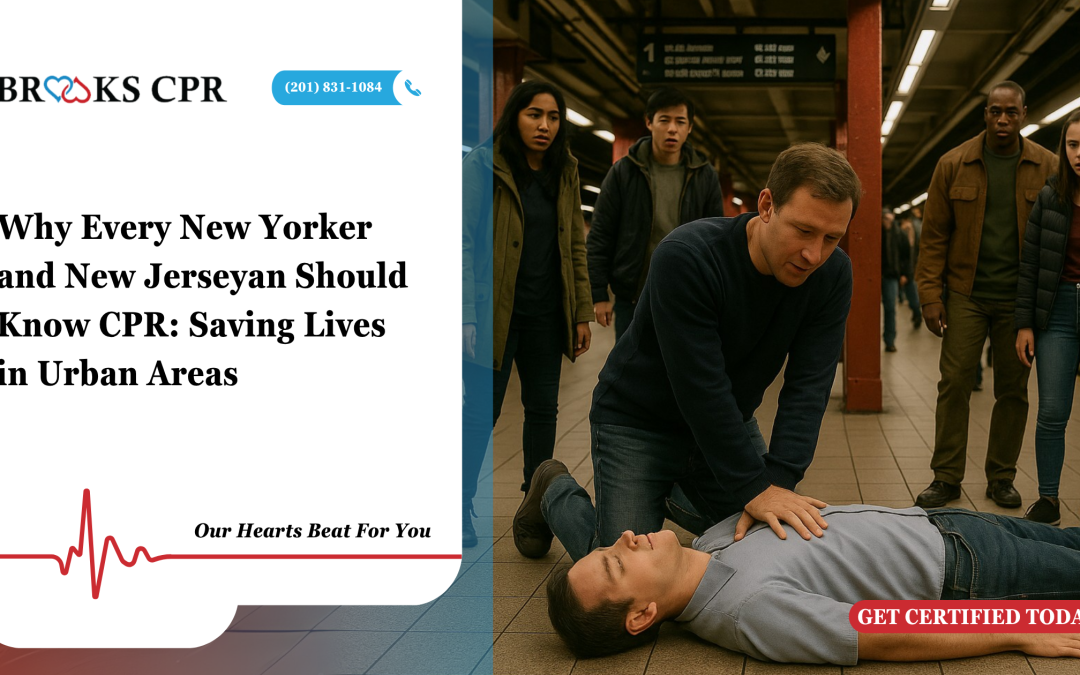
Living in the tri-state area means we’re all connected—whether we’re sharing a subway car, waiting in line at our favorite deli, or watching our kids play in the same parks.
We look out for each other, and that sense of community runs deep.
But here’s something that might surprise you: in the time it takes for an ambulance to navigate through Manhattan traffic or reach a suburban New Jersey neighborhood, you could literally save someone’s life with your own two hands.
CPR training isn’t just for medical professionals or first responders. It’s for everyday people like you and me—parents, commuters, neighbors—who want to be prepared to help when it matters most.
Because in our densely populated area, the person who needs help might be sitting right next to you.
The Urban Reality: Why CPR Skills Matter More in NY & NJ
When someone collapses on a crowded subway platform or has a heart attack in a Manhattan office building, the clock starts ticking immediately.
Our metropolitan area presents unique challenges that make CPR knowledge not just helpful, but absolutely critical for anyone who lives, works, or visits here.
Longer Emergency Response Times in Metropolitan Areas
Picture an ambulance trying to reach someone in Midtown during rush hour, or navigating the narrow streets of an older New Jersey neighborhood.
The reality is that even our incredibly skilled emergency responders face obstacles that can add precious minutes to their response times.
Here’s what we’re dealing with in our metropolitan area:
- Average ambulance response times in NYC can reach 13 minutes for life-threatening emergencies, and even longer in some boroughs
- Brain damage can occur within 4-6 minutes of cardiac arrest—meaning there’s often a critical gap where immediate action is needed
- Traffic jams, construction zones, and urban density create unavoidable delays for emergency responders
That might not sound like much, but when someone’s heart has stopped beating, those minutes are everything.
The person standing next to someone in crisis often has the power to prevent permanent damage or death, simply because they’re already there when every second counts.
Common Scenarios Where CPR is Needed
The situations where CPR knowledge becomes essential aren’t rare or far-fetched—they’re part of daily life in our busy metropolitan area:
- Subway stations and public transit: Cardiac arrests during morning commutes, where stress, heat, and crowds can trigger medical emergencies
- Office buildings: High-stress work environments throughout Manhattan and New Jersey that can lead to sudden cardiac events
- Restaurants and crowded events: Choking incidents at everything from street festivals in Brooklyn to corporate gatherings in Jersey City
- Waterfronts and pools: Drowning emergencies at Coney Island, Jersey Shore beaches, or community pools throughout our boroughs
Each of these scenarios has something in common—they happen in places where you’re likely to be, surrounded by people who could help if they knew how.
At Brooks CPR, we see firsthand how these urban realities make CPR training not just valuable, but essential for anyone who calls this area home.
The dense population that defines our region means you’re more likely to encounter someone who needs help—and more likely to be that crucial first responder who can make all the difference.
How Bystander CPR Saves Lives in Crowded Places
The difference between life and death often comes down to one simple factor: whether someone nearby knows what to do.
In our densely populated area, where thousands of people pass each other every day, ordinary residents have become unlikely heroes simply by learning CPR and being willing to act when it matters most.
The Power of Immediate Action
The statistics tell a sobering story, but they also reveal an incredible opportunity.
Nearly 9 out of 10 people who experience cardiac arrest outside of a hospital die, largely because they don’t receive CPR quickly enough.
But here’s what gives us hope: immediate CPR can double or triple the chances of survival.
Think about what this means in practice:
- Without CPR: A person’s chance of survival drops by 7-10% for every minute that passes
- With immediate bystander CPR: Survival rates can jump from around 10% to 30% or even higher
- In urban settings: Bystanders are often the first—and sometimes only—line of defense until EMS arrives
When you’re surrounded by people in places like Times Square, a busy New Jersey mall, or a packed subway car, those numbers become deeply personal.
The person next to you isn’t just another face in the crowd—they could be someone’s lifeline, or you could be theirs.
Real-Life Impact: A Story from Our Community
David was volunteering at a youth basketball game in Queens when one of the referees suddenly clutched his chest and fell to the gym floor.
While parents called 911, David stepped forward and began chest compressions. “I kept thinking about what my instructor said—don’t stop, don’t second-guess yourself, just keep going,”
David remembers. “The paramedics told me later that those first few minutes probably saved his life.”
The referee made a complete recovery, and David’s story shows how CPR training turns community volunteers into potential lifesavers.
Stories like David’s happen more often than you might think throughout our community.
Local CPR training programs have been reaching residents throughout New York and New Jersey, and thousands of people have gained the confidence to step up in emergencies.
These aren’t medical professionals or first responders—they’re teachers, parents, shop owners, and commuters who decided to learn a skill that could save a life.
What makes these local success stories so powerful is how ordinary they are.
The people who perform life-saving CPR aren’t superheroes—they’re regular folks who:
- Took a few hours to learn proper technique: Basic CPR certification can be completed in just one afternoon
- Stayed calm under pressure: Training builds the confidence to act when adrenaline is high
- Recognized that their actions mattered: Understanding that doing something—even imperfectly—is almost always better than doing nothing
At Brooks CPR, we hear these stories regularly from our graduates throughout New York and New Jersey.
Each one reinforces what we already know: when communities are trained and prepared, lives get saved. The next success story could easily be yours.
Why CPR Certification Is a Civic Responsibility in NY & NJ
When more residents know CPR, something remarkable happens—our entire community becomes more resilient.
It’s not just about individual preparedness; it’s about creating a network of people who can respond when emergencies strike.
Here’s what happens when CPR training becomes widespread in our area:
- Safer neighborhoods and workplaces: Every trained person becomes a potential first responder, dramatically improving emergency response coverage
- Empowered everyday citizens: Parents, teachers, and commuters gain the confidence to step up when someone needs help, rather than feeling helpless
- Stronger community bonds: Knowing that your neighbors are trained and ready to help creates a deeper sense of connection and security
This isn’t just theory—we see it play out regularly throughout New York and New Jersey.
When a community center in Queens starts offering CPR classes, workplace incidents in the area get better outcomes.
When a group of parents in a New Jersey suburb all get certified together, they’re not just preparing for their kids’ sports games—they’re creating a safety net for their entire neighborhood.
Creating a culture where helping others is part of our urban identity feels natural here.
We already live it every day when we offer directions to lost visitors, help someone carry a stroller up subway steps, or check on elderly neighbors during heat waves.
CPR certification is simply the next level of that same community spirit.
Who Should Get Certified?
The short answer?
Almost everyone.
But let’s be practical about who benefits most from CPR training in our metropolitan area.
High-priority groups include:
- Parents and caregivers: Whether you’re at a playground in Central Park or a family gathering in New Jersey, you want to be prepared for any emergency involving the children in your care
- Teachers and school staff: Working with kids means being ready for everything from playground accidents to more serious medical emergencies
- Coaches and youth program leaders: Sports activities and physical programs carry inherent risks that trained adults can help mitigate
- Anyone spending significant time in crowded public spaces: Regular subway riders, frequent event-goers, and urban professionals encounter hundreds of people daily
Workplace and community leaders should also consider certification:
- Employees in high-traffic businesses: Restaurant staff, retail workers, and office employees in busy buildings are often the first on scene when emergencies happen
- Building staff and security personnel: Doormen, maintenance workers, and security teams are natural first responders in residential and commercial buildings
- Community volunteers: Whether you’re involved in local events, religious organizations, or neighborhood groups, your training could make you a valuable community resource
The beautiful thing about CPR certification is that it doesn’t require any special background or extensive medical knowledge.
We’ve trained everyone from busy Manhattan executives to retired grandparents in New Jersey, and they all walk away feeling more confident and prepared to help their community when it matters most.
Ready to Make a Difference in Your Community?
You’ve learned why CPR skills are so crucial in our metropolitan area, and you’ve seen how ordinary people just like you have become lifesavers in their neighborhoods.
The question now isn’t whether you should get CPR certified—it’s how soon you can make it happen.
Every day you wait is another day you might encounter someone who needs help while you’re still wishing you knew what to do.
But here’s the good news: you’re already closer to being prepared than you think.
The decision to learn CPR is often the hardest part—everything else is just scheduling and showing up.
If you’re ready to talk about CPR certification or want to bring life-saving skills to your family, workplace, or community group in NY or NJ, we’d love to help.
You can visit https://brookscprnynj.com/ to get started, explore your options, and take that first step toward becoming someone who’s ready to save a life.
The next emergency in your neighborhood is unpredictable, but your response doesn’t have to be.
Let’s get you prepared.