
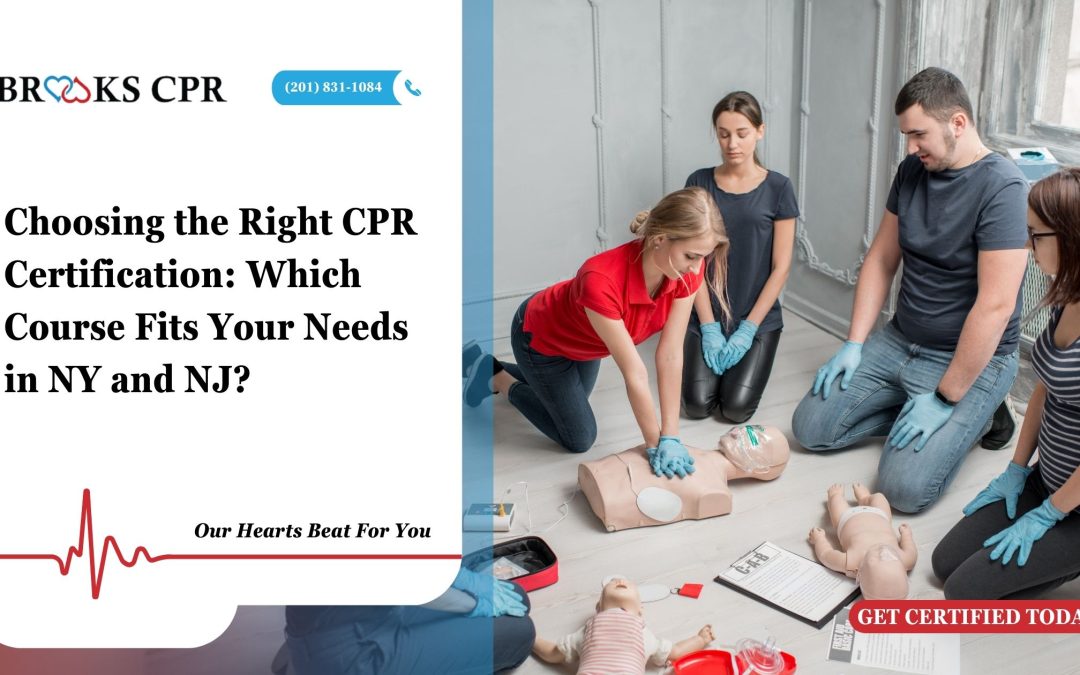
Navigating the world of CPR certification options doesn’t have to be overwhelming.
We’ve guided thousands of New York and New Jersey residents through selecting the perfect training course that aligns with their professional requirements and personal goals.
Understanding CPR Certification Options
Each certification pathway serves a distinct purpose, whether you’re seeking basic skills or advanced medical training.
Let’s explore the options available across our Brooklyn, Manhattan, and New Jersey locations to find your ideal match.
Basic CPR and AED Training for the General Public
Our Heartsaver CPR/AED courses provide fundamental lifesaving skills accessible to anyone, regardless of medical background.
These classes equip you with confidence to respond during those critical moments before professional help arrives.
- Learn essential adult, child, and infant CPR techniques tailored to different age groups
- Master AED operation through hands-on practice with training devices
- Complete the course in approximately 3-4 hours with substantial practice time
- Receive certification valid for two years, with convenient renewal options
- Perfect solution for parents concerned about home safety, youth sports coaches, and community volunteers
Basic Life Support (BLS) for Healthcare Providers
Healthcare professionals require more advanced training that accounts for their clinical responsibilities and team-based approach to emergencies.
Our BLS certification meets American Heart Association standards recognized by medical facilities throughout NY and NJ.
- Develop proficiency in professional-level CPR techniques including two-rescuer scenarios
- Learn the science behind high-quality compressions and their impact on survival rates
- Practice AED integration within clinical workflows and emergency response systems
- Fulfill certification requirements for doctors, nurses, EMTs, dental professionals, and healthcare students
- Gain skills that seamlessly transfer between hospital settings, private practices, and pre-hospital care
First Aid with CPR & AED Combination Courses
Expanding your emergency response capabilities beyond cardiac events provides comprehensive preparation for a wider range of situations.
These combination courses deliver well-rounded skills for everyday emergencies.
- Address bleeding emergencies with proper wound care and bleeding control techniques
- Recognize and respond appropriately to seizures, allergic reactions, and other medical crises
- Learn practical injury management for sprains, fractures, and environmental emergencies
- Complement CPR skills with additional lifesaving interventions
- Ideal certification for teachers responsible for student safety, workplace first responders, and fitness professionals
Advanced Cardiac Life Support (ACLS) & Pediatric Advanced Life Support (PALS)
For healthcare providers seeking specialized training in advanced emergency cardiovascular care, these courses represent the gold standard in resuscitation education.
These certifications build upon BLS foundations with sophisticated clinical interventions.
- Develop advanced skills for treating cardiac arrests, stroke, and other life-threatening conditions
- Consider these certifications when working in emergency departments, critical care, or specialized units
- Take advantage of combination class schedules that efficiently fulfill multiple requirements
- Meet prerequisites including current BLS certification and familiarity with ECG interpretation
- Maintain professional credentials through streamlined recertification programs every two years
Finding Your Perfect CPR Course in NY and NJ
Selecting the right CPR certification involves considering your specific role, requirements, and learning preferences.
Our team helps match you with the perfect course structure to ensure you receive training that’s truly relevant to your needs.
For Healthcare Professionals
BLS Provider certification forms the foundation of clinical emergency response capabilities, serving as the gateway to advanced credentials.
Your workplace may specify particular training requirements beyond the standard certification.
- Verify your employer’s exact certification requirements – some facilities prefer specific provider cards or training centers
- Explore blended learning options combining online coursework with in-person skills verification to accommodate busy schedules
- Consider how specialized certifications might enhance your career trajectory in specialized units or leadership roles
- Look for training centers with instructors who have real healthcare experience and understand clinical scenarios
- Take advantage of our healthcare provider courses taught by active medical professionals who relate content to practical applications
For Educators and Childcare Workers
Educational professionals face specific certification requirements that vary between New York and New Jersey, with particular emphasis on child and infant techniques.
Meeting these standards ensures both compliance and genuine preparedness.
- Review your state’s specific requirements – New York and New Jersey have different certification standards for educators
- Confirm your school district’s approved training providers before enrolling in any course
- Consider organizing on-site group training at your school to ensure consistent emergency protocols among staff
- Focus on courses emphasizing child and infant techniques relevant to your daily responsibilities
- Schedule training during professional development days to maximize participation without disrupting class time
For Parents and Family Caregivers
Family-focused CPR training provides targeted skills for home emergencies, with special attention to infant and child techniques that address common household scenarios.
These courses create a safety foundation for your family.
- Look for family-focused courses that welcome parents to learn together in a supportive environment
- Prioritize training with extensive practice on infant manikins for realistic skill development
- Learn comprehensive choking response techniques for different age groups and common choking hazards
- Explore community center courses often offered at reduced rates compared to certification classes
- Consider hosting a neighborhood CPR class where friends and families can learn together in a familiar setting
For Workplace Compliance
Businesses benefit from CPR training that addresses industry-specific scenarios while meeting OSHA guidelines and minimizing disruption to operations.
Workplace certification creates a safer environment for both employees and customers.
- Select OSHA-aligned training that fulfills workplace safety requirements and compliance standards
- Explore on-site corporate training options that can be customized to your workplace layout and specific risks
- Inquire about group rates that make comprehensive training financially accessible for your entire team
- Request industry-specific scenarios relevant to your workplace during hands-on practice sessions
- Utilize certification tracking services to ensure timely renewals and maintain continuous workplace coverage
Course Format Considerations
Choosing the right course format significantly impacts your learning experience and retention of these critical skills.
We offer various delivery methods to accommodate different learning styles and scheduling needs.
In-Person Traditional Classes
Traditional in-person classes remain the gold standard for developing confident, competent rescuers through immersive hands-on practice.
These instructor-led sessions provide the most comprehensive skill development experience.
- Benefit from direct instructor guidance with immediate technique corrections that develop proper muscle memory
- Practice on high-quality mannequins that provide realistic feedback on compression depth and technique
- Use the same AED models and emergency equipment you might encounter in real-life situations
- Learn from other participants’ questions and scenarios, creating a richer learning environment
- Choose from multiple locations across Brooklyn, Manhattan, Queens, and New Jersey for maximum convenience
Hybrid and Blended Learning Options
Blended learning combines the convenience of self-paced online study with essential in-person skills verification.
This format respects your time while ensuring you develop proper technique through hands-on practice.
- Complete cognitive learning at your own pace before attending a focused skills session
- Save up to 50% of total training time compared to traditional courses without sacrificing quality
- Access engaging videos, interactive scenarios, and knowledge checks that enhance retention
- Review digital resources before and after your skills session to reinforce learning
- Benefit from pandemic-inspired improvements in online learning design and digital resources
Making Your Decision
Several practical factors should influence your final course selection to ensure your certification meets your specific needs.
Certification Recognition and Credibility
The value of your CPR certification depends entirely on its recognition by employers, licensing boards, and institutions.
Investing in properly accredited training saves headaches down the road.
- Verify that your potential training provider issues American Heart Association, American Red Cross, or other nationally recognized certification
- Check with your employer or school about their specific provider requirements before enrolling
- Look for training centers with proper accreditation and instructor credentials clearly displayed
- Ask about digital certification verification systems that allow employers to confirm your status
Cost Considerations
Certification costs vary based on course level, format, and provider, with prices typically ranging from $19.95 for basic online components to $75+ for comprehensive in-person professional certifications.
- Understand exactly what’s included in course fees – quality providers include all materials and certification cards
- Check whether your employer offers reimbursement programs for job-required certifications
- Explore group discount options that can reduce per-person costs by 15-25% for workplace or family groups
- Compare value between providers by considering instructor qualifications and facility quality, not just price
Scheduling and Convenience
Finding a course that fits your schedule improves your learning experience and reduces stress.
We offer flexible scheduling options to accommodate diverse needs.
- Choose between weekend courses that don’t interfere with work schedules or weekday options
- Consider evening classes that begin after typical work hours for minimal disruption
- Select from training locations throughout Brooklyn, Manhattan, and New Jersey to minimize travel time
- Register in advance for guaranteed spots in popular certification classes
- Explore expedited options when facing tight deadlines for employment or credential requirements
Recertification Planning
Planning ahead for recertification ensures continuous coverage and compliance with professional requirements.
Most CPR certifications require renewal every two years.
- Mark your calendar for renewal approximately 3 months before your card’s expiration date
- Understand that recertification courses are typically shorter and focused on updates and skill refreshers
- Practice compression techniques periodically between certifications to maintain muscle memory
- Sign up for digital reminder services that alert you when renewal approaches to avoid certification gaps
Taking the Next Step Toward CPR Certification
The journey to CPR certification is ultimately about preparedness—being ready to respond when seconds count.
Whether you’re fulfilling a professional requirement or preparing to protect loved ones, the right training makes all the difference in emergency outcomes.
At Brooks CPR, we’ve guided thousands of New Yorkers and New Jersey residents through this important decision process.
Our team understands that each person’s certification needs are unique, which is why we offer personalized guidance to help match you with the perfect course.
We encourage you to review your specific requirements, consider your learning preferences, and evaluate scheduling options that work realistically with your life.
Remember that quality training focuses not just on certification but on developing the confidence and competence to act decisively during emergencies.
Ready to find your perfect CPR certification path? Browse our upcoming classes across Brooklyn, Manhattan, and New Jersey locations, or contact our certification advisors with any questions about which course best fits your needs.
Your decision to learn these skills might one day give someone a second chance at life—there’s no greater gift than that.