
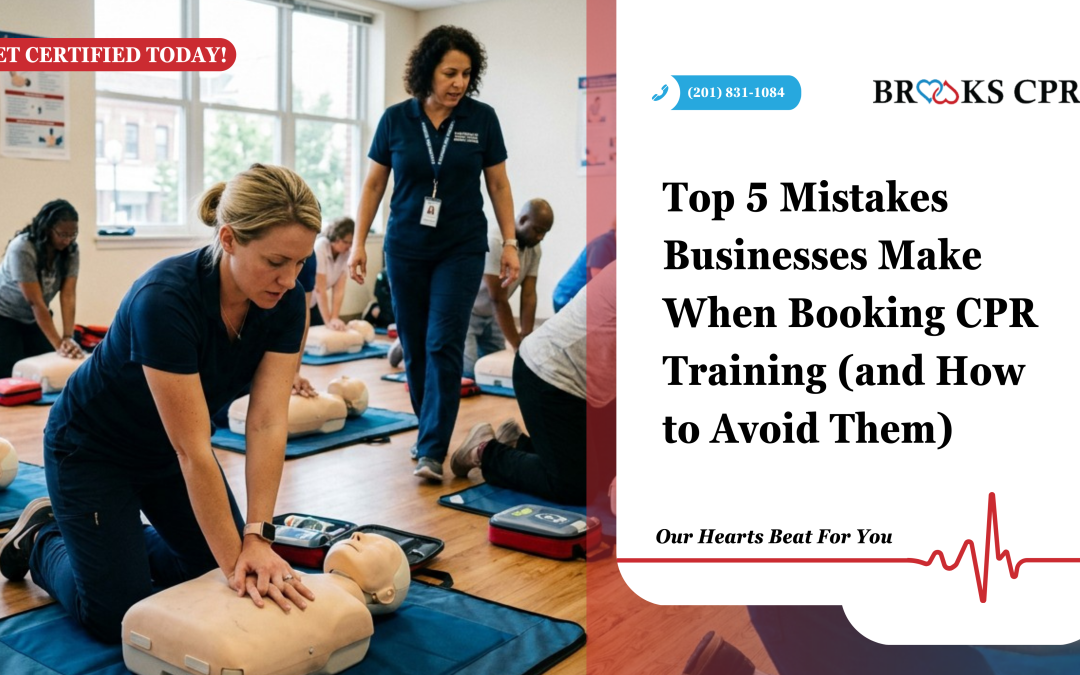
Booking CPR training for your team sounds straightforward until you’re in the middle of it and realize there are more decisions involved than you expected.
The truth is, some of the most common CPR training mistakes businesses make have nothing to do with the training itself. They happen before the instructor even walks in the door.
This guide walks you through the top five mistakes NY and NJ employers make when booking CPR training and, more importantly, how to avoid them.
Mistake #1: Choosing a CPR Provider That Isn’t AHA-Authorized
Not all CPR certifications are created equal, and booking with the wrong provider can cost your business more than just time.
Why Accreditation Matters for NY & NJ Businesses
If your CPR certification isn’t AHA-recognized, it may not be accepted by the organizations that matter most to your business.
Here’s why accreditation is a big deal:
- Hospitals, clinics, and healthcare employers across New York and New Jersey typically require AHA-recognized certifications as a condition of employment or credentialing. A certificate from an unrecognized provider often won’t clear HR.
- Schools, childcare centers, and licensed facilities in NY and NJ are frequently required by state licensing boards to maintain staff certifications from approved, recognized programs.
- Insurance requirements for certain businesses may also specify accredited training, meaning a “fast card” from a non-accredited source could leave you exposed if an incident ever occurs.
Beyond compliance, there’s a quality difference too. AHA-aligned training means:
| Feature | AHA-Authorized Training | Non-Accredited/”Fast Card” |
| Follows latest resuscitation guidelines | ✅ Yes | ❌ Not guaranteed |
| Hands-on, skills-based practice | ✅ Required | ❌ Often skipped |
| Accepted by hospitals & licensing boards | ✅ Widely recognized | ❌ Frequently rejected |
| Certification validity period clear | ✅ Standardized | ❌ Varies or unclear |
The bottom line: a cheaper, faster certification that doesn’t hold up when it counts isn’t a deal, it’s a liability.
Questions to Ask Before You Book
Before you commit to any CPR training provider, run through these quick vetting questions:
- “Is this course AHA-aligned, and will my staff receive an AHA-recognized certification?”
- “Will this certification be accepted by my hospital, school district, or licensing board in NY or NJ?”
- “How long is the certification valid, and how will I receive proof of completion?”
- “Do you offer group or on-site training, and can you accommodate our team size?”
If a provider hesitates or gives vague answers to any of these, that’s your sign to keep looking.
At Brooks CPR, we only teach American Heart Association–authorized courses, so our New York and New Jersey clients can be confident their certifications will be recognized by employers, licensing boards, and healthcare institutions alike.
Mistake #2: Ignoring Your Industry’s Specific CPR Training Requirements
Booking CPR training is a great step, but booking the wrong course can mean your staff still aren’t compliant, even after completing it.
Not All CPR Courses Are the Same
Here’s a quick breakdown of the most common CPR course types in plain language:
| Course Type | Who It’s For |
| BLS (Basic Life Support) | Healthcare providers like nurses, doctors, dentists, and medical assistants |
| ACLS (Advanced Cardiovascular Life Support) | Advanced clinical staff managing cardiac emergencies |
| PALS (Pediatric Advanced Life Support) | Healthcare providers who work with infants and children in clinical settings |
| Heartsaver CPR/AED | General workplace employees, office staff, gym workers, retail teams |
| Pediatric First Aid/CPR | Childcare workers, teachers, camp counselors, and school staff |
Choosing the wrong course is a surprisingly common mistake. A Heartsaver certification, for example, won’t satisfy BLS requirements for a nurse or dental hygienist. And a healthcare-focused BLS course isn’t what a daycare director in New Jersey needs for state licensing compliance.
Getting this wrong means your team sits through training, gets a certificate, and still doesn’t meet the requirements of their employer, professional board, or state regulation.
Matching CPR Training to Your Team in NY & NJ
Here are some concrete examples of how course selection should line up with your industry:
- Hospitals, clinics, and dental offices in New York and New Jersey typically require BLS certification for clinical staff, and certain roles like ER nurses or respiratory therapists may also need ACLS or PALS.
- Schools, daycares, and youth programs often need Pediatric Heartsaver CPR/AED and First Aid to meet state childcare licensing requirements in NY and NJ.
- Offices, warehouses, gyms, and retail locations are well served by Heartsaver CPR/AED, with or without First Aid, depending on workplace safety policies or insurance requirements.
- Fitness professionals and personal trainers often need Heartsaver or a comparable course that specifically covers AED use, which is increasingly required by gyms and fitness facilities.
- Construction and industrial worksites may need First Aid combined with CPR/AED training to satisfy OSHA-related safety requirements.
When a practice manager or school administrator reaches out to our team, the first thing we do is ask about their industry, staff roles, and NY/NJ regulatory needs before recommending a course. That way, no one wastes time or money on training that doesn’t actually check the right boxes.
Mistake #3: Booking CPR Training That Doesn’t Fit Your Team’s Schedule
Even the best CPR course falls flat if half your team can’t make it, or shows up exhausted and checked out.
One-Size-Fits-All Scheduling Leads to No-Shows
Here’s what poor scheduling actually looks like in practice:
- Training booked during peak hours means staff are mentally elsewhere, thinking about the customers, patients, or tasks waiting for them.
- Night-shift workers asked to attend early-morning classes are essentially being trained while sleep-deprived, which isn’t great for retention or skills practice.
- No staggered sessions means an entire department goes offline at once, which simply isn’t realistic for most businesses.
This is especially common in New York and New Jersey workplaces where teams are stretched across multiple locations, shifts, and commutes. Think about a healthcare network with staff rotating between a Manhattan clinic and a Staten Island facility, or a warehouse operation in Newark running three shifts around the clock. A single Tuesday morning class doesn’t work for everyone.
The real cost of poor scheduling isn’t just no-shows. It’s staff who technically completed training but were too distracted or fatigued to absorb it, which defeats the whole purpose.
Flexible CPR Training Options for NY & NJ Workplaces
The good news is that scheduling conflicts are completely avoidable with the right provider. Here are the options worth looking for:
| Training Format | Best For |
| On-site group classes | Teams that want training brought directly to their workplace |
| Multiple session times | Businesses with rotating shifts or large staff numbers |
| Evening and weekend classes | Staff who can’t step away during regular business hours |
| Blended learning | Teams that want to complete theory online and finish skills in person |
Some practical examples of how flexible scheduling plays out across the region:
- A Hackensack medical office can book an after-hours BLS session so clinical staff don’t have to miss patient appointments.
- A retail chain with locations across New York City and Newark can stagger training across two weekends instead of pulling everyone in at once.
- A daycare in Staten Island can use blended learning so teachers complete the online portion at home and come in just for the hands-on skills check.
At Brooks CPR, we regularly schedule group CPR classes around New York and New Jersey shift patterns, offering evening, weekend, and blended options so your team can train without disrupting operations. The goal is to make it easy for every staff member to show up ready to learn, not just show up.
Mistake #4: Overlooking Location and On-Site Logistics in NY & NJ
You can book the right course, at the right time, with a great instructor, and still have a frustrating training day if the logistics aren’t thought through.
Parking, Transit, and Classroom Space Really Matter
Logistics might not seem like a training issue, but they directly affect who shows up and how much they get out of it. Here’s what tends to go wrong:
- Limited parking or poor transit access means staff arrive late, stressed, or not at all. This is a real issue in busy corridors like Hoboken, Jersey City, and Midtown Manhattan where parking is scarce and commutes are unpredictable.
- Rooms that are too small for manikins, AED trainers, and a group of people moving around create cramped, uncomfortable conditions that cut into the quality of hands-on practice.
- Noise, interruptions, and foot traffic in the training area are more common than you’d think, especially when businesses try to use a busy breakroom or open office space. It’s hard to focus on chest compression technique when coworkers are walking through mid-session.
The reality of training in New York and New Jersey adds another layer of complexity. NYC offices are often tight on space, parking in suburban New Jersey corridors can be surprisingly difficult, and staff may be commuting from different boroughs or cities just to attend.
Choosing the Right Training Setup for Your NY & NJ Team
There are two main options, and both have their place depending on your situation:
| Setup | Pros | Best For |
| Training at a dedicated CPR center | Purpose-built space, proper equipment, no workplace interruptions | Smaller teams, businesses without suitable on-site space |
| On-site training at your location | No commute for staff, familiar environment, flexible for large teams | Businesses with adequate space and multiple employees to train |
Whichever route you go, here are a few practical tips to make sure the day runs smoothly:
- Confirm room size and layout in advance. A good rule of thumb is to ensure there’s enough floor space for each participant to kneel beside a manikin comfortably.
- Ask about equipment. Make sure manikins, AED trainers, and any first aid supplies are included and accounted for before the day of training.
- Share clear directions, parking info, and entry instructions with all staff ahead of time, especially if people are coming from different locations across New York or New Jersey.
- Minimize interruptions. If training is on-site, block off the space and let the rest of the team know it’s off-limits during the session.
Because Brooks CPR has dedicated training locations and also offers on-site sessions across New York and New Jersey, we help businesses choose the setup that makes it easiest for their staff to attend, participate, and actually walk away with skills they’ll remember.
Mistake #5: Failing to Plan Recertification and Long-Term Compliance
Getting your team certified once is a great start. Keeping them certified is where a lot of businesses drop the ball.
Letting CPR Certifications Expire
A few things worth knowing about CPR certification expiration:
- Most AHA certifications are valid for two years. That window moves faster than people expect, especially when HR plates are full and compliance tracking isn’t centralized.
- Expired certifications create real risk. If a cardiac emergency happens and your staff member’s certification has lapsed, it can raise serious questions about duty of care, liability, and regulatory compliance for your business.
- CPR guidelines get updated. The American Heart Association periodically revises its resuscitation guidelines based on the latest science. Staff who were certified several years ago may be practicing outdated techniques without realizing it.
- Last-minute bookings create headaches. When recertification isn’t planned ahead, businesses often find themselves scrambling for open class spots, paying more for rush scheduling, or pushing staff through training under pressure, none of which leads to great outcomes.
Setting Up a Simple Recertification System for NY & NJ Businesses
The good news is that staying on top of recertification doesn’t have to be complicated. Here’s a straightforward system that works well for most NY and NJ businesses:
| Step | What to Do |
| 1. Build a central tracking sheet | List every staff member, their role, certification type, and expiration date |
| 2. Set calendar reminders | Flag certifications 60 to 90 days before they expire to give yourself enough lead time |
| 3. Schedule recurring group sessions | Partner with a local provider for annual or biennial group training built into your calendar |
| 4. Review after any staff changes | New hires and role changes should trigger an immediate check of certification requirements |
A few reasons why proactive planning also makes financial sense:
- Group sessions are almost always more cost-effective than booking individual students repeatedly throughout the year.
- Avoiding last-minute single bookings saves money and reduces the scheduling stress that leads to poor attendance.
- Consistent training cycles mean your team stays sharp rather than relearning everything from scratch every two years.
We help New York and New Jersey organizations at Brooks CPR set up recurring CPR training and recertification plans so they stay compliant without scrambling every time a card is about to expire. Whether you need annual refreshers or a full biennial cycle for a large team, having a plan in place makes the whole process smoother for everyone involved.
How to Book CPR Training the Right Way in NY & NJ
If you’ve made it this far, you now know what to avoid. Here’s what to actually do instead.
A Simple Checklist for Local Employers
Work through these steps before you book anything and you’ll save yourself a lot of back-and-forth later:
- Identify your team. Who needs CPR training, and what are their roles? A nurse and a front desk receptionist likely need different courses.
- Confirm the course type. Based on your industry and staff roles, determine whether you need BLS, ACLS, PALS, Heartsaver, Pediatric Heartsaver, or a combination.
- Decide on format. Would your team do better with in-person group training, on-site instruction at your workplace, or a blended learning option that splits theory and skills practice?
- Choose a location. Figure out whether it makes more sense to bring training to you or send staff to a nearby training site in Hackensack, Newark, Staten Island, or another convenient location.
- Check accreditation. Confirm the provider is AHA-authorized or aligned with another recognized body accepted by your employer, licensing board, or insurance carrier in NY or NJ.
- Plan your dates. Work around shift schedules, peak business periods, and staff availability so attendance is high and no one is rushing in distracted.
- Map out recertification. Before the ink is dry on this round of training, decide how you’ll track expiration dates and when you’ll schedule the next cycle.
How We Support NY & NJ Organizations Through the Process
Booking CPR training doesn’t have to feel like another item piling up on your to-do list. When you reach out to Brooks CPR, we walk you through this checklist step by step, helping you choose the right course, format, and schedule for your New York or New Jersey team.
The goal isn’t just to get your staff certified and move on. It’s to make CPR training a straightforward, repeatable part of how your organization operates, so that when it matters most, your people are ready.
Make CPR Training a Strength, Not a Stressor for Your NY & NJ Team
Avoiding the wrong provider, wrong course, poor scheduling, logistical headaches, and lapsed certifications all comes down to one thing: planning ahead with a provider who knows what your business actually needs.
When that’s in place, CPR training stops being a stressor and becomes a simple, repeatable part of keeping your team safe and compliant.
If you’re ready to get it right, our team at Brooks CPR is here to help NY and NJ organizations choose the right course, format, and schedule from the start. Reach out and let’s build a plan that works for your team.