
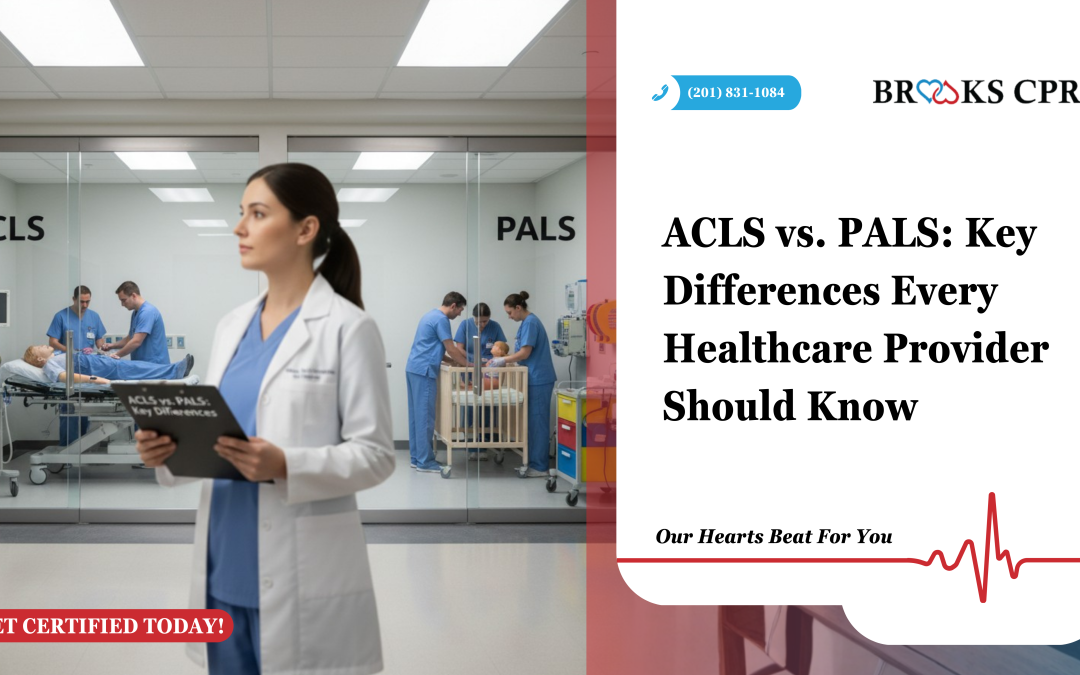
ACLS vs. PALS: The main difference is simple—ACLS (Advanced Cardiovascular Life Support) is designed for treating adults in cardiac emergencies, while PALS (Pediatric Advanced Life Support) focuses on infants and children. But if you’re standing at a crossroads wondering which certification you actually need, you’re not alone.
I’ve talked with countless healthcare providers who felt uncertain about which course to take first, or whether they needed both. Maybe you’re a new nurse trying to figure out your next step, or perhaps you’re switching specialties and want to make sure you’re prepared.
The truth is, understanding these two certifications doesn’t have to be complicated. Let’s walk through what makes each one unique, so you can move forward with confidence about which path is right for you.
What Is ACLS and Who Needs It in NY/NJ?
ACLS (Advanced Cardiovascular Life Support) is your go-to certification when adult patients experience cardiac arrest, stroke, or other life-threatening emergencies. It builds on BLS by teaching you to recognize dangerous rhythms, administer the right medications, manage advanced airways, and lead a resuscitation team through high-pressure situations.
ACLS Basics and Clinical Focus
ACLS prepares you to handle adult cardiac and respiratory emergencies with confidence and precision. Here’s what you’ll master:
Core ACLS Skills:
- Algorithm mastery – Step-by-step protocols for cardiac arrest, bradycardia, tachycardia, stroke, and acute coronary syndromes
- ECG interpretation – Reading rhythms quickly to identify shockable vs. non-shockable situations
- Emergency pharmacology – Knowing when and how to push epinephrine, amiodarone, atropine, and other critical drugs
- Advanced airway management – Proper use of supraglottic airways and endotracheal intubation support
- Team dynamics – Clear communication, role delegation, and closed-loop feedback during codes
The entire course revolves around real-world scenarios where seconds matter and your clinical judgment can change outcomes.
ACLS Course Format, Length, and Renewal
How ACLS is delivered:
| Format | What It Includes | Time Commitment |
| Blended Learning | Online modules (self-paced) + in-person skills session | 6–8 hours total |
| In-Person | Full classroom instruction with hands-on practice | 1–2 days (typically 8–16 hours) |
| Skills Check-Off | Required hands-on evaluation for both formats | 2–4 hours |
Renewal cycle: Every 2 years. Most providers take a shorter renewal course (4–6 hours) rather than repeating the full initial certification.
Many people appreciate the blended option because you can knock out the theory at home, then come in just for the hands-on megacode simulations and skills testing.
ACLS for Adult-Focused Providers in New York and New Jersey
ACLS is the standard for healthcare professionals working with adult patients in critical or emergency settings across the NY/NJ area.
Who typically needs ACLS certification:
- Emergency Department nurses and physicians – Fast-paced ERs in NYC, Newark, Jersey City, and Hackensack demand quick rhythm recognition and code response
- ICU and critical care nurses – Whether you’re in a medical ICU, cardiac ICU, or step-down unit, ACLS is usually required
- Hospitalists and internal medicine physicians – You’re the first responder when patients deteriorate on the floor
- Anesthesiologists and CRNAs – Airway experts who manage emergencies in the OR and beyond
- Paramedics and flight nurses – Pre-hospital and transport teams running codes in the field
- Telemetry, cath lab, and procedural staff – Anyone monitoring cardiac patients or performing interventions
Local search examples: If you’re looking for training nearby, you might search “ACLS classes in Hackensack,” “ACLS certification for New York City hospital staff,” or “ACLS renewal course NJ.”
We see many NY/NJ ED and ICU nurses start their advanced training with ACLS because most of their patients are adults. The skills translate immediately to bedside practice—whether you’re in a Manhattan teaching hospital or a community facility in Bergen County.
We structure our ACLS classes around real cases providers face on New York and New Jersey units, not just exam scenarios, so you leave ready to lead your next code with clarity and composure.
What Is PALS and Who Needs It in NY/NJ?
PALS (Pediatric Advanced Life Support) is the essential certification for anyone caring for critically ill or injured infants and children. It teaches you how to assess pediatric patients systematically, recognize early signs of deterioration, and intervene before a sick child becomes a coding child.
PALS Basics and Clinical Focus
PALS is designed specifically for the unique physiology and emergency needs of pediatric patients—from newborns to adolescents. Children aren’t just small adults, and this course makes that crystal clear.
Core PALS Skills:
- Pediatric assessment triangle – Rapid visual evaluation of appearance, work of breathing, and circulation to identify severity
- Age-specific vital signs and norms – Knowing what’s normal for a 2-month-old vs. a 10-year-old so you catch abnormalities fast
- Respiratory emergencies – Managing upper and lower airway obstruction, respiratory distress, and respiratory failure (the most common pediatric crises)
- Shock recognition and treatment – Identifying hypovolemic, distributive, cardiogenic, and obstructive shock early and supporting circulation aggressively
- Pediatric cardiac arrest algorithms – CPR quality, rhythm recognition, medication dosing by weight, and post-arrest care
- Team-based resuscitation – Coordinating roles, family presence, and high-performance teamwork during pediatric codes
The course emphasizes catching problems early—respiratory failure and shock—before they lead to full arrest, because early intervention dramatically improves outcomes in kids.
PALS Course Format, Length, and Renewal
How PALS is delivered:
| Format | What It Includes | Time Commitment |
| Blended Learning | Online cognitive modules + in-person skills and simulations | 7–9 hours total |
| In-Person | Full classroom instruction with case-based scenarios | 2 days (typically 12–16 hours) |
| Skills Testing | Hands-on evaluation of pediatric resuscitation skills | 3–4 hours |
Renewal cycle: Every 2 years. Renewal courses are shorter (usually 4–6 hours) and focus on updates and skills reinforcement.
Most providers appreciate the blended format because you can complete the theory modules on your own schedule, then attend a focused skills session where you practice megacodes with infant and child manikins.
PALS for Pediatric-Focused Providers in New York and New Jersey
PALS certification is required or strongly recommended for healthcare professionals who care for children in emergency, critical care, or high-acuity settings across the NY/NJ region.
Who typically needs PALS certification:
- Pediatric ED nurses and physicians – Busy pediatric ERs in NYC, Newark, and surrounding areas see everything from febrile infants to trauma
- PICU and NICU nurses – Critical care units demand advanced skills in managing unstable neonates and children
- Pediatricians and family medicine physicians – Especially those working in urgent care, walk-in clinics, or community practices
- Respiratory therapists – Key team members managing pediatric airways and ventilation
- School nurses and urgent care staff – Front-line responders when children experience emergencies outside the hospital
- Transport teams and flight nurses – Specialists who stabilize and move critically ill children between facilities
Local search examples: Providers often look for “PALS certification for pediatric nurses in New Jersey,” “PALS provider course in New York City,” or “PALS renewal class near me NJ.”
We regularly train pediatric nurses and physicians from hospitals in Hackensack and New York City who need PALS to care for their youngest patients.
During our NY/NJ PALS courses, we focus on recognizing early warning signs in children—respiratory distress turning into failure, subtle signs of compensated shock—which local providers tell us is critical on their units.
You’ll leave knowing how to assess a sick child quickly, intervene confidently, and work seamlessly with your team when every second counts.
ACLS vs. PALS: How to Decide Which You Need in the NY/NJ Area
The short answer: it depends on who you’re treating. ACLS focuses on adults, PALS focuses on children, and some providers need both. Let’s break down how to choose the right certification for your role in the NY/NJ healthcare landscape.
Adult vs. Pediatric Track (or Both)
Quick decision guide:
| Your Patient Population | Certification Priority | Why |
| Primarily adults (ED, ICU, telemetry, cath lab, medical-surgical floors, EMS) | ACLS first | You’ll manage adult cardiac arrests, strokes, ACS, and arrhythmias regularly |
| Primarily pediatric (pediatric ED/ICU, NICU/PICU, pediatric clinics, school health) | PALS first | Children have unique physiology, medication dosing, and assessment needs |
| Mixed populations (community ED, family practice, urgent care, flight/transport teams) | Both, over time | Start with whichever you encounter most, then add the other within 6–12 months |
| Emergency or critical care roles (paramedics, ER nurses, critical care transport) | Plan for both | Emergencies don’t discriminate by age—you need to be ready for anyone who rolls through the door |
Real-world examples:
- ICU nurse at a New York City hospital caring for post-surgical adults? ACLS is your must-have.
- Pediatric hospitalist at a New Jersey children’s hospital? PALS is non-negotiable.
- ED nurse in a Hackensack community hospital that sees all ages? You’ll likely need both eventually, but check which one your unit prioritizes first.
Most providers find it easier to master one certification thoroughly before adding the second. The algorithms and muscle memory are similar, but trying to learn both simultaneously can feel overwhelming.
Matching Certifications to Local Employer Requirements
Before you register, check your specific requirements. Hospitals, clinics, and EMS agencies across New York and New Jersey each have their own credentialing policies, and assuming you know what you need can lead to last-minute surprises.
What to verify with your employer:
- Does your unit require ACLS, PALS, or both for your role?
- Is there a timeline for completion (e.g., within 90 days of hire, before the end of orientation)?
- Do they accept blended learning, or do they require full in-person courses?
- Is BLS also required? (Spoiler: it almost always is—BLS is the foundation for both ACLS and PALS)
Common NY/NJ scenarios:
- Adult ICU or telemetry nurse: BLS + ACLS required, PALS optional
- Pediatric ED nurse: BLS + PALS required, ACLS occasionally preferred
- Paramedic or flight nurse: BLS + ACLS + PALS all typically required
- Medical resident or hospitalist: BLS + ACLS standard, PALS depends on patient population
When providers call us from NY/NJ hospitals or EMS agencies, we review their unit’s requirements and help them decide whether ACLS, PALS, or both are necessary right now.
We often recommend starting with ACLS for adult-focused roles, then adding PALS if you transition into pediatrics or mixed emergency care in New York or New Jersey.
Pro tip: If you’re job hunting or switching specialties, having both certifications on your resume makes you significantly more marketable across the NY/NJ region. It signals versatility and readiness for any clinical environment.
How We at Brooks CPR Make ACLS and PALS Easy for NY/NJ Providers
Getting advanced certifications shouldn’t feel like another stressful item on your to-do list.
We’ve spent over 15 years fine-tuning our approach so NY/NJ healthcare providers can get certified quickly, confidently, and without disrupting their demanding schedules.
Convenient ACLS and PALS Options in New York and New Jersey
Brooks CPR is an American Heart Association-authorized training center with deep roots in the NY/NJ healthcare community. Since our founding, we’ve certified thousands of providers across the region in BLS, ACLS, PALS, and Heartsaver courses.
What makes us convenient:
- Multiple training locations – Including our Hackensack facility and other accessible sites throughout New York and New Jersey
- Flexible formats to fit your life:
- In-person classes – Full instruction and hands-on practice in one session
- Blended learning – Complete online modules at home, then attend a shorter in-person skills session
- Group and corporate training – We bring ACLS and PALS directly to your hospital, clinic, or practice
- In-home private sessions – Perfect for small teams or providers who need individualized attention
- Same-day certification available – Register in the morning, walk out certified by evening when you need it fast
Whether you’re an ED nurse in Manhattan, a pediatrician in Jersey City, or part of a hospital system in Bergen County, we have an option that works with your schedule and location.
Fast, Practical Training for Busy Healthcare Schedules
You don’t have time to sit through hours of lecture that doesn’t translate to real practice. That’s why we built our training around what actually works.
Our teaching approach:
| Feature | Why It Matters |
| Practice-while-you-watch method | You’re not passively listening—you’re doing. Watch a skill demonstrated, then immediately practice it yourself |
| RN instructors with real-world experience | Our instructors have run actual codes in NY/NJ hospitals and know the difference between textbook scenarios and 3 AM emergencies |
| Scenario-based learning | Every case reflects situations you’ll actually encounter on your unit or in the field |
| Small class sizes | More hands-on time, personalized feedback, and chances to ask questions |
| Efficient scheduling | Most courses wrap up in a single day or evening, so you’re not sacrificing multiple shifts |
Our ACLS and PALS classes are led by experienced RNs who understand NY/NJ hospital workflow and teach what actually happens during real codes—not just what’s in the manual. We designed our schedules so New York and New Jersey providers can renew ACLS or PALS without losing valuable work hours or scrambling to find coverage.
Need certification fast? Many of our students register for same-day classes and walk out certified within 24 hours—perfect when a new job starts Monday or your card expires this week.
The goal is simple: get you trained, confident, and certified as efficiently as possible so you can get back to doing what you do best—caring for patients.
Ready to Get Certified?
You know the difference between ACLS vs. PALS now—time to pick the one that matches your patients and get it done. Whether you need ACLS for adult care, PALS for pediatrics, or both for a mixed-age setting, we’re here to make certification quick and painless.
Check out our ACLS and PALS courses, find a class that fits your schedule, or give us a call if you have questions. We’ve helped thousands of NY/NJ healthcare providers get certified—you’re next.
Visit Brooks CPR to get started and check this off your list today!