
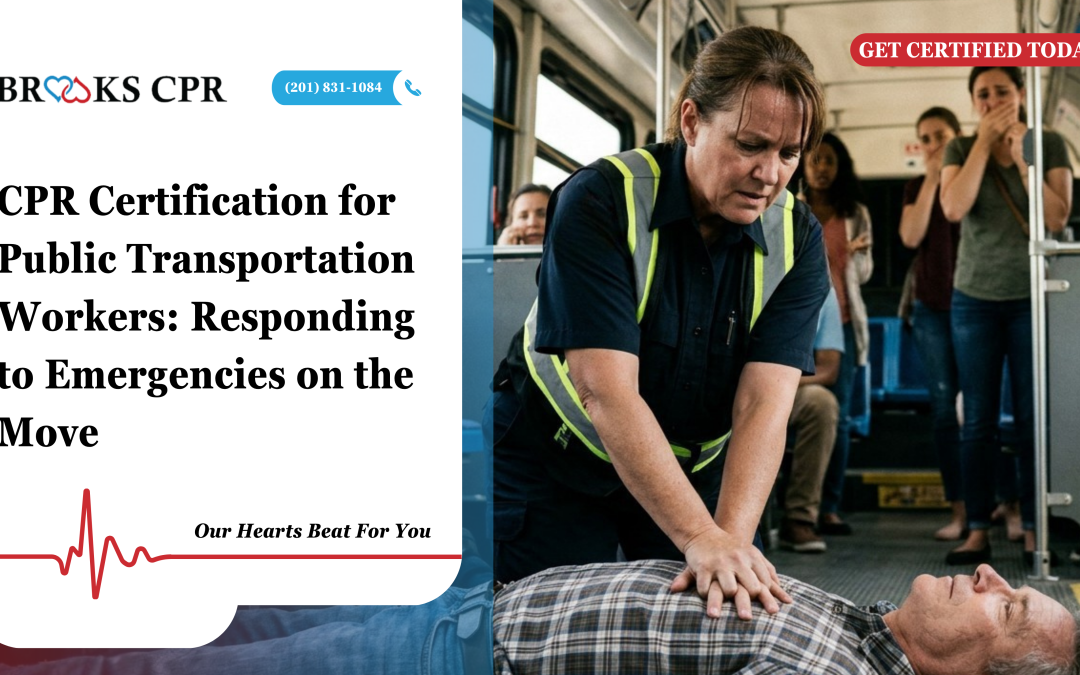
CPR certification is essential for public transportation workers who may be the first to respond during a cardiac emergency on a bus, train, or platform. In New York and New Jersey, where millions of commuters depend on public transit every day, quick action can save a life.
CPR can greatly improve a person’s chance of survival after cardiac arrest. But many people still do not get help before emergency responders arrive, according to the American Heart Association. As a transit worker, you may be the one who steps in first.
This guide explains what CPR and AED training looks like for transit professionals, why your role matters in an emergency, and how to find a certification class that fits your schedule.
What CPR Certification Means for Public Transportation Workers
CPR, or cardiopulmonary resuscitation, is a hands-on emergency technique that keeps blood and oxygen moving when someone’s heart stops beating. For public transportation workers, CPR certification means you have the verified skills to respond when a passenger or colleague needs urgent help.
Transit workers encounter medical emergencies in environments where professional medical help may be minutes away.
A passenger could go into sudden cardiac arrest on a bus, collapse on a subway platform, or become unresponsive on a ferry. In those moments, a certified transit worker is often the first trained person on the scene.
These emergencies can happen across every mode of transit, including:
- Buses and shuttles, where you may be the only staff member present
- Train cars and subway platforms, often crowded and far from station exits
- Ferries and water transit, where emergency services face longer response times
- Transit stations and terminals, which serve high volumes of people daily
It is also important to understand the difference between CPR certification and general awareness training:
| Awareness Training | CPR Certification | |
| Format | Informational, often online | Hands-on, skills-based |
| Assessment | No formal skills test | Must pass a skills evaluation |
| Recognition | Not employer-recognized | Meets workplace and industry standards |
| Preparedness | Knows what CPR is | Can actually perform CPR |
Which CPR Class Is Right for You?
Not all CPR classes are the same, and choosing the right one depends on your role in public transportation. We help transit workers find the course that matches their responsibilities and meets their employer’s requirements.
Here is a plain-language breakdown of the most common certifications:
| Certification | What It Covers | Best For |
| CPR/AED | Chest compressions, rescue breaths, and AED use | General transit staff, drivers, station agents |
| CPR + First Aid | CPR skills plus wound care, choking, and injury response | Frontline staff who may handle a range of emergencies |
| BLS (Basic Life Support) | Advanced CPR techniques, two-rescuer CPR, bag-mask use | Transit supervisors, security personnel, or those in higher-risk roles |
| ACLS (Advanced Cardiovascular Life Support) | Complex cardiac emergency management | Transit-employed nurses, paramedics, or medical staff only |
For most non-clinical transit workers, a CPR and First Aid course is the most practical starting point. It gives you the core skills to handle the emergencies you are most likely to encounter on the job.
Supervisors and team leads may benefit from BLS certification, which prepares you to coordinate a response and support other rescuers on scene.
To find out exactly what your role requires, we recommend:
- Checking your employee handbook or onboarding materials for any listed certification requirements
- Contacting your HR or safety department directly to confirm accepted certification providers
- Reviewing agency or union guidelines, especially for federally regulated transit systems
The American Red Cross notes that workplace CPR requirements vary by industry and employer, so verifying with your organization ensures you take the right class the first time.
What to Expect in CPR Training
CPR training is hands-on, straightforward, and designed for people with no medical background. Most participants complete their certification in a single session, leaving with the skills and confidence to respond when it matters most.
Class Format and Skills Covered
Our classes combine short instructional segments with plenty of hands-on mannequin practice. You will not spend the whole session sitting through lectures. Skills covered in a typical CPR certification class include:
- Chest compressions, including proper hand placement, depth, and rate
- Rescue breaths and when to use compression-only CPR
- AED operation, including how to set up and use an automated external defibrillator
- Recognizing cardiac arrest so you can act quickly and confidently
- Choking response for adults (included in CPR + First Aid courses)
How Certification Is Earned
At the end of class, an instructor observes and evaluates your technique through a short skills assessment. Students who pass receive a certification card valid for two years.
Online vs. In-Person Options
| Format | What It Includes | Employer Accepted? |
| In-person | Full hands-on practice and skills test | Yes |
| Blended (online + in-person) | Online knowledge portion, in-person skills check | Yes, for most employers |
| Online only | Knowledge content, no skills check | Generally not accepted |
Why Choose Brooks CPR in Hackensack, Newark, and Staten Island
Brooks CPR offers certified CPR training to transit workers and organizations across Hackensack, Newark, and Staten Island. Our classes are taught by experienced instructors, follow nationally recognized standards, and are designed to fit the schedules of working professionals.
Instructors and Training Standards
Our instructors bring real-world emergency experience into every class. They are certified through recognized national bodies and stay current with the latest CPR and first aid guidelines. Every course we offer meets the standards that employers, agencies, and safety officers expect.
Key reasons transit teams trust Brooks CPR:
- Experienced, certified instructors who make hands-on practice clear and approachable
- Courses aligned with American Heart Association and American Red Cross standards, which are widely accepted by employers and regulatory agencies
- Small class sizes that give every participant enough time on the mannequin to build real confidence
- Flexible scheduling, including evening and weekend sessions for shift workers
Onsite Corporate Training
We bring training directly to your facility, which makes certification easier to coordinate for large teams.
HR managers and safety officers can schedule a session for their entire department without asking staff to travel or take extra time off. Onsite training also allows us to tailor scenarios to your specific transit environment.
Who We Serve
| Who | How We Help |
| Individual transit workers | Affordable, flexible classes close to home or work |
| HR teams | Group scheduling, rosters, and certification tracking support |
| Safety officers | Compliant training that meets agency and regulatory standards |
We are proud to serve the communities we live and work in, and we take that responsibility seriously every time someone walks through our door.
Your Team’s Preparedness Starts Here
Public transportation workers are on the front lines every day, and medical emergencies do not wait for a convenient moment.
CPR certification gives you and your team the practical skills to respond with confidence, whether you are behind the wheel, on a platform, or aboard a vessel.
At Brooks CPR, we make the process simple, flexible, and accessible for transit workers across Hackensack, Newark, and Staten Island. If you are ready to get certified or want to schedule onsite training for your team, we would love to help you take that next step.