
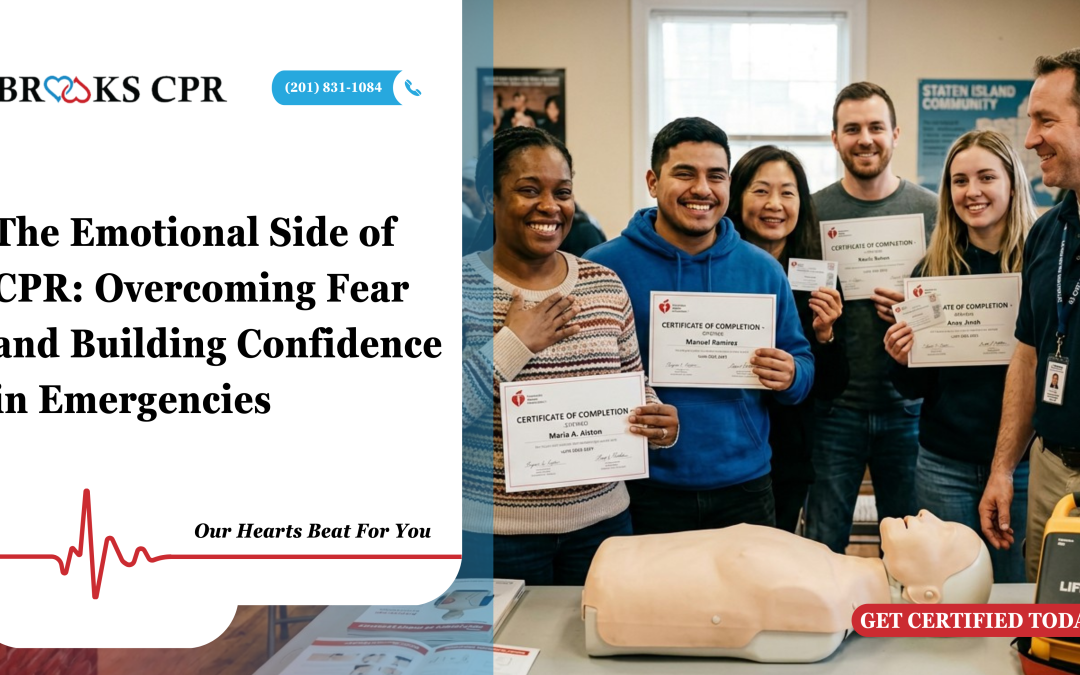
No one expects to be standing next to someone who needs CPR. And yet, ordinary people find themselves in that position every single day, and most of them will tell you their first reaction was pure fear.
That frozen feeling, the racing thoughts, the worry about doing something wrong: it’s one of the most common and least talked-about parts of emergency response. And it makes sense. You care, but you’ve never had a safe space to work through it.
That’s exactly what good CPR training does. At Brooks CPR NY NJ, serving Hackensack, Newark, and Staten Island, we’ve watched nervous beginners walk out genuinely ready. This article will show you why fear is normal and how CPR training can help you move through it.
Why So Many People Feel Afraid to Perform CPR in Real Emergencies
Fear is one of the biggest reasons bystanders hesitate during cardiac emergencies. Understanding where that fear comes from is the first step to overcoming it.
The Fear of “Messing Up” or Making Things Worse
This is the number one concern we hear from students. What if I press too hard? What if I break a rib? What if I do it wrong and hurt them?
Those fears are completely understandable. But here’s what the research and experience consistently show:
- Broken ribs can happen during CPR and are more common in older patients, but they are treatable. Cardiac arrest is not.
- Doing nothing has a near-zero survival outcome. Every minute without CPR reduces survival chances by roughly 10%.
- Imperfect CPR is still CPR. Compressions that aren’t perfectly textbook can still keep blood and oxygen moving to the brain.
The goal in cardiac arrest isn’t perfection. It’s action.
We’ve met countless students who were terrified of “doing it wrong,” and we walk them step-by-step through what really matters in those crucial first minutes. By the time they leave a CPR training session, most of them are surprised by how much more manageable it feels.
Worrying About Legal Issues and Responsibility
Another fear that holds people back is the worry about consequences. What if something goes wrong? Could I get in trouble for trying to help?
It’s a fair concern, and you’re not alone in thinking about it. Here’s what’s helpful to know:
| What People Fear | What’s Generally True |
| Being sued for helping | Good Samaritan laws exist in most U.S. states to protect bystanders acting in good faith |
| Getting in trouble if CPR doesn’t work | These laws are specifically designed to encourage people to help without fear of legal blame |
| Only trained people are protected | Many states extend protections to untrained bystanders as well |
Good Samaritan laws vary by state, so this isn’t legal advice. But knowing these protections exist in places like New Jersey and New York can make a real difference in how willing someone feels to step in.
When you take a CPR training course, your instructor can also help you feel more informed and less anxious about this side of things.
Emotional Overload: Panic, Shock, and Freezing Up
Witnessing someone collapse is traumatic. Even people who want to help can find themselves completely frozen, not because they’re cowardly, but because the human brain under sudden stress doesn’t always behave the way we expect.
This is called the freeze response, and it’s a well-documented reaction to shock and fear. It can affect anyone, regardless of how calm or capable they are in everyday life.
Here’s why realistic CPR training helps break that pattern:
- Repetition builds muscle memory. When your hands have done compressions before, they’re more likely to move on their own even when your mind is racing.
- Practice under simulated pressure helps your nervous system recognize the scenario as something you’ve been through before.
- Scenario-based training reduces the element of shock, because you’ve already practiced responding to a collapsed person in a controlled, supportive setting.
The freeze response doesn’t disappear overnight. But every practice session chips away at it. That’s why hands-on CPR training, not just watching a video, makes such a meaningful difference when a real emergency happens.
How CPR Training Builds Confidence and Emotional Resilience in New York and New Jersey Communities
Confidence in an emergency doesn’t come from reading about CPR. It comes from doing it, repeating it, and doing it again until it feels natural. Here’s how the right training gets you there.
Hands-On Practice That Turns Knowledge Into Muscle Memory
There’s a big difference between knowing what CPR looks like and knowing how to do it. Watching a demonstration or reading the steps is a starting point, but it’s the physical practice that actually prepares you for a real emergency.
In a hands-on CPR training class, you practice:
- Positioning your hands correctly on the chest
- Pressing to the right depth, roughly 2 to 2.4 inches for adults
- Maintaining a steady rhythm of 100 to 120 compressions per minute
- Delivering rescue breaths with the right technique and timing
- Switching roles with a partner to manage fatigue during longer scenarios
In our classes at Brooks CPR NY NJ, we don’t just teach techniques. We help you practice until your body knows what to do, even when your mind feels stressed. That’s the kind of preparation that actually holds up when it matters most.
The more you repeat these steps on a manikin in a calm, guided setting, the more automatic they become. And when something becomes automatic, fear has a lot less power over it.
Learning in a Supportive Group, Not Alone
One of the most underrated parts of in-person CPR training is the people around you. When you’re learning alongside neighbors, coworkers, classmates, or family members, something shifts.
Here’s what a group learning environment does for you:
- It normalizes fear. When someone else in the room admits they’re nervous too, it immediately feels less isolating.
- It creates accountability. Practicing with others keeps you engaged and motivated in a way that solo online learning simply can’t replicate.
- It builds encouragement. A good instructor and a supportive group can turn a room full of anxious beginners into a room full of capable, confident people in just a few hours.
- It reflects your real community. The people you train with are often the same people you’d encounter in an actual emergency, which makes the whole experience feel more relevant and meaningful.
CPR training at a local level, whether that’s in Hackensack, Newark, or Staten Island, connects you to the community you actually live and work in. That connection matters more than most people realize.
The Mental Health Benefits of Knowing CPR
Something quietly powerful happens after people complete CPR training. They feel different going about their everyday lives.
Research and anecdotal experience both point to the same thing: people who are trained in CPR report feeling less helpless, less anxious, and more grounded when they think about emergencies. That shift in mindset has real mental health value.
Here’s what that looks like in practice:
| Before CPR Training | After CPR Training |
| Feeling frozen or helpless at the thought of an emergency | Feeling prepared and capable of taking action |
| Avoiding thinking about emergencies because they feel overwhelming | Feeling calmer because you have a plan |
| Worrying about being a bystander who can’t help | Feeling empowered to be someone who can |
| Anxiety about loved ones in vulnerable situations | Greater peace of mind knowing you could step in |
Knowing CPR doesn’t make you fearless. But it does make you less afraid. It builds a quiet kind of confidence that stays with you, not just in emergencies, but in how you show up for the people around you every day.
How to Start Overcoming Your Fear: Simple Steps You Can Take Today in NY and NJ
You don’t have to wait until you feel ready. The truth is, taking that first step is exactly what makes you feel ready. Here’s how to begin.
Acknowledge Your Fear, Then Learn the Facts
The worst thing you can do with fear is ignore it. The best thing you can do is name it.
Take a moment to identify what specifically worries you about performing CPR. Is it one of these?
- Fear of pressing too hard and hurting someone
- Worry about freezing up and not remembering what to do
- Concern about legal responsibility if something goes wrong
- Anxiety about being in an emotionally overwhelming situation
- Self-doubt about whether you’re physically capable
Once you name the fear, you can start looking at the facts around it. And more often than not, the facts are a lot more reassuring than the worry.
For example:
| The Fear | The Fact |
| I might break someone’s ribs | Rib injuries during CPR are possible but treatable. Cardiac arrest without CPR is far more dangerous. |
| I’ll forget everything in the moment | Hands-on training builds muscle memory that kicks in even under stress |
| I could get in legal trouble | Good Samaritan laws in New York and New Jersey are designed to protect people who help in good faith |
| I’ll freeze and be useless | Realistic practice scenarios train your brain and body to respond instead of shutting down |
Knowledge is one of the most effective tools for reducing fear. The more clearly you understand what CPR actually involves and what really matters in those first minutes, the less power the fear has over you.
Choose a Local CPR Class That Feels Safe and Supportive
Not all CPR training experiences are the same. The environment you learn in makes a real difference, especially if anxiety is already part of the picture.
When looking for a CPR class, consider these factors:
- Small class sizes that give you personal attention and room to ask questions without feeling judged
- Experienced instructors who understand that many students come in feeling nervous
- Plenty of hands-on practice time, not just lectures or videos
- A welcoming, pressure-free atmosphere where making mistakes is part of the learning process
- A convenient location that removes the excuse of “it’s too far” from getting in the way
That last point matters more than people think. Having a training center close to home or work lowers the barrier to actually showing up. Brooks CPR NY NJ has locations in Hackensack, Newark, and Staten Island specifically to serve local communities across New York and New Jersey, so getting started doesn’t have to mean a long commute or complicated scheduling.
We’re here to walk with you from that first moment of “I could never do this” to the quiet confidence of knowing you really can.
Keep Your Skills and Confidence Fresh Over Time
Getting certified is a great first step. Staying confident is an ongoing process.
CPR skills, like most physical skills, fade without practice. And when skills fade, so does confidence. That’s why recertification and refresher courses are such an important part of feeling genuinely prepared over the long term.
Here’s what regular CPR training does for you over time:
- Keeps your technique accurate and up to date with any guideline changes
- Reinforces muscle memory so your response stays automatic rather than something you have to think hard about
- Rebuilds confidence after a gap in practice
- Gives you a regular reminder that you are capable and prepared
- Offers a chance to ask new questions that may have come up since your last class
Most CPR certifications are valid for two years. Scheduling your recertification before that window closes means you never have to start from scratch, and you never have to let fear creep back in simply because too much time has passed.
Confidence in CPR is not a one-time achievement. It’s something you maintain, and every refresher class is a reminder that you have what it takes to help when it counts.
Ready to Feel More Confident in an Emergency? Take the Next Step With Brooks CPR NY NJ
If something in this article resonated with you, that’s worth paying attention to. Feeling scared about CPR is completely normal. But those feelings don’t have to hold you back from being someone who’s ready when it counts.
Taking a CPR class isn’t about getting a card to put in your wallet. It’s about knowing that if something happened to someone you love, you wouldn’t feel helpless. That peace of mind is something no online video can give you.
Taking the next step is simple:
- Visit brookscprnynj.com to explore upcoming class dates
- Choose a location convenient to you in Hackensack, Newark, or Staten Island
- Reach out with any questions before you sign up, the team is happy to help
If you’re ready to feel more prepared, not just technically but emotionally, we at Brooks CPR NY NJ would be honored to train with you. You don’t have to feel fearless to get started. You just have to show up.