
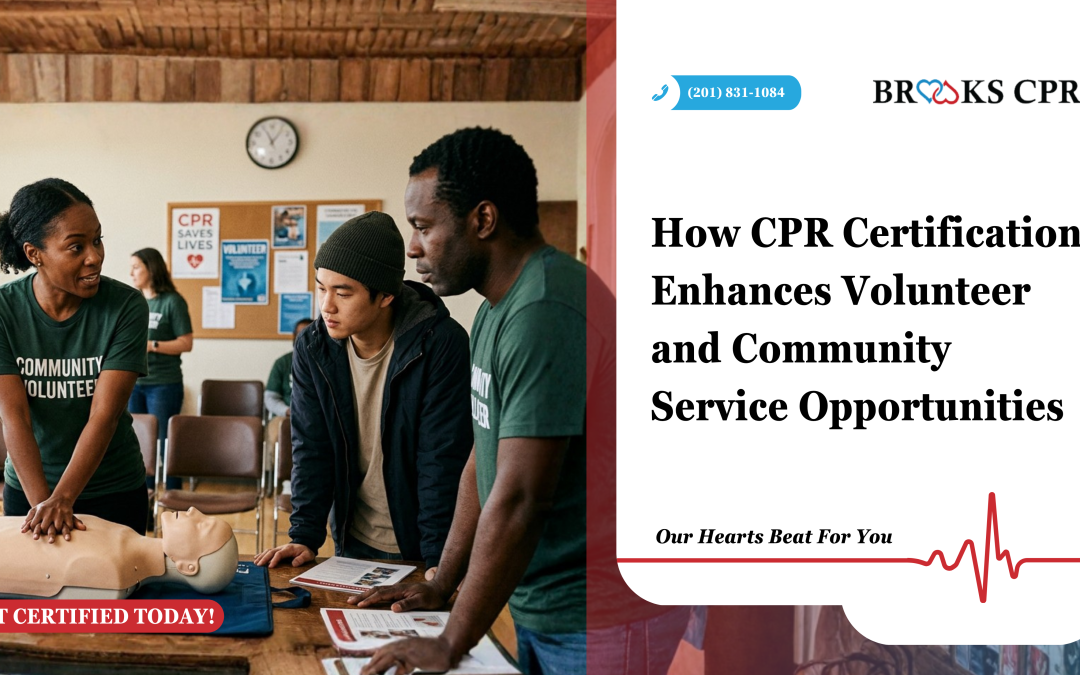
CPR certification opens doors to meaningful volunteer roles and community service positions that require life-saving skills. Certified individuals are more trusted, better prepared, and often prioritized for placement in high-impact settings like shelters, schools, and community events.
Whether you’re looking to join a local response team, support a nonprofit, or simply show up more prepared for the people around you, having a CPR credential signals that you’re ready to act when it matters most.
Brooks CPR offers hands-on CPR training, First Aid, BLS, and ACLS courses across New York and New Jersey, including Hackensack, Newark, and Staten Island.
This guide walks you through how earning your certification can expand your service opportunities, strengthen your community’s resilience, and give you the quiet confidence that comes from being genuinely prepared.
1. It Makes Your Application Stronger
CPR certification for volunteers is increasingly listed as a preferred or required credential on volunteer applications. When coordinators are comparing two candidates with similar availability and experience, the one with current certification often moves forward.
This is especially true for roles involving children, older adults, or large crowds. Completing a recognized certification course shows that you took extra steps before you even walked in the door.
Here are some of the roles where certification commonly gives applicants an edge:
- School and after-school program volunteers
- Youth sports coaches and sideline assistants
- Nonprofit event staff and coordinators
- Faith-based organization support teams
- Senior care and assisted living volunteers
2. It Increases Trust With Coordinators
Emergency response training tells a coordinator something important: this volunteer will not freeze if something goes wrong. That confidence matters in safety-sensitive settings where coordinators are responsible for everyone present.
According to FEMA’s community preparedness research, organizations and communities are meaningfully safer when more individuals are trained to respond in emergencies. Coordinators know this, and they tend to lean on certified volunteers when situations get serious.
3. It Helps in Real Emergencies
CPR and AED training prepares you for the moments that actually count. Cardiac emergencies can happen at school events, sports practices, faith gatherings, and care facilities, often without any warning.
The American Red Cross reports that nearly 70 percent of out-of-hospital cardiac arrests happen in homes or community settings, where a trained bystander may be the first and only responder. Knowing what to do in those first minutes can be the difference between life and death.
4. It Opens Doors to More Specialized Roles
Some volunteer positions require CPR certification as a baseline before you can even apply. Without it, those opportunities are simply not available to you.
The table below shows how certification requirements tend to vary by role type:
| Volunteer Role | CPR Certification Typically Required? |
| Youth sports coach | Yes, often mandatory |
| School reading or tutoring volunteer | Preferred but sometimes optional |
| Community event first aid support | Yes, almost always required |
| Disaster relief team volunteer | Yes, required |
| Faith community outreach volunteer | Preferred in many programs |
Earning your certification expands the range of roles you are eligible for and shows organizations that you are serious about taking on more responsibility.
5. It Keeps You Prepared Beyond the Role
The skills you gain through CPR training do not stay at the volunteer site. You carry them to your neighborhood, your home, and anywhere you happen to be when an emergency strikes.
Research published through the National Institutes of Health suggests that widespread CPR training in communities is directly linked to higher survival rates from cardiac arrest. Being a certified volunteer means you are contributing to that larger safety net every single day.
How to Choose the Right CPR Class
Finding the right CPR classes in New York and New Jersey comes down to three things: what certification you need, where you can realistically get to, and how you learn best. Answering those questions first will save you time and make sure your certification actually fits your goals.
Check the Certification Type
Not all CPR courses are the same, and the right one depends on what you plan to do with it. Here is a quick breakdown of the most common options:
| Course | Best For |
| CPR and First Aid | General volunteers, community members, parents |
| BLS (Basic Life Support) | Healthcare students, clinical volunteers, medical staff |
| ACLS (Advanced Cardiovascular Life Support) | Experienced healthcare providers and professionals |
Choose a Convenient Local Location
One of the most common reasons people put off getting certified is the hassle of travel. That is why we offer CPR classes in Hackensack, Newark, and Staten Island, covering a wide range of the New York and New Jersey area so you can find a location that works for your schedule.
If you have been searching for CPR classes near me and coming up short, our three locations are designed to serve communities across both states without a long commute.
Look for Hands-On Training
Hands-on CPR training is not just a nice extra, it is how people actually learn to perform compressions correctly and build the muscle memory they need in a real emergency.
Online-only courses can cover the theory, but they cannot replace practicing on a mannequin with an instructor watching and giving feedback.
Research supported by the American Heart Association consistently shows that skill retention is significantly higher when training includes physical practice. Our courses at Brooks CPR are built around that hands-on experience from start to finish.
What to Expect in CPR Training
A CPR training course is designed to be approachable, even if you have never done anything like it before. Most people walk in a little nervous and leave feeling genuinely confident and ready. Here is what a typical class looks like.
Skills Practice
The core of any good CPR class is time spent actually doing the skills. In our courses, you will practice:
- Chest compressions with correct depth, rate, and hand placement
- Rescue breathing and proper airway positioning
- AED use, including pad placement and following device prompts
- Scenario-based learning where you respond to simulated emergencies as a team
Instructors guide you through each skill and give real-time corrections so you leave knowing you are doing it right, not just thinking you are.
Testing and Completion
Most CPR certification courses include a brief skills check at the end, and some include a short written or digital quiz. Neither is meant to be stressful. They are simply a way to confirm that you can perform the techniques you practiced.
According to the American Heart Association, students who complete a full certification course, including a skills evaluation, are far better prepared to act confidently in cardiac emergencies. Once you pass, you receive a certification card or digital completion record that you can share with volunteer coordinators, employers, or schools right away.
Your Community Needs People Who Are Ready
Volunteering is one of the most meaningful things you can do for the people around you, and CPR certification makes that contribution even more valuable.
At Brooks CPR, we offer CPR training, First Aid, BLS, and ACLS courses at our locations in Hackensack, Newark, and Staten Island, so getting certified is straightforward no matter where you are in the New York and New Jersey area.
Whether you are applying for your first volunteer role or looking to take on more responsibility in your community, we are here to help you get there.
Reach out to our team today and let us help you take that next step!